Coaching to Apply the 80-20 Rule to Productivity and Time Management
- Home
- Basic Productivity Skills
- Coaching to Apply the 80-20 Rule to Productivity and Time Management
Make use of this self-paced coaching to apply the 80-20 rule to productivity and time management improvement for your work and projects. Get your most productive work done in less time.
Note: You may sometimes hear of this referred to as the 80/20 Rule, Pareto Principle, Law of the Vital Few, and less frequently the Principle of Factor Sparsity. Let's stick with the 80-20 Rule so we can keep those two numbers in mind, 80 and 20.
Start with this Summary and Instructions
1. Learn what the 80-20 Rule is and how it works
2. Work through the 5 days of coaching and action planning, aided by two downloadable worksheet audits
- Assessing your high-value time and activities - the 20%
- Assessing your lower-value time and activities - the 80%
3. Take advantage of the Two Bonus Worksheets which help you assess and adjust your habits and systems to avoid four common contributors to leadership burnout.
- The first examines Calendar overload, and People Fatigue
- The second one examines Too Many Meetings, and Disorganized Weekly Planning
4. Finally, score yourself at the beginning and end of the 5 Days of Coaching, using the "Record Your Progress" scale at the bottom of the page.
- Come back one month later and score yourself again to track progress. Adjust your practices to continue building on your success.
5. If this resource was helpful for you, it will be helpful for your team. Pass along the link coaching to apply the 80-20 rule to productivity and time management to other colleagues.
Understand What the 80-20 Rule Is and How it Works

The 80-20 Rule says that you will get 80% of your most productive work done in 20% of your time.
How does that work to help me get a priority task done?
The first thing you'll do is find that small sliver of time, approximately 20% out of your work day when you are most effective. Then you will guard it from interruptions. Step-by-step guidance is below in the coaching section.
If 80% of your time is less productive, imagine what you can get accomplished, if by being intentional you made even a small improvement in productivity, regaining three, five or even ten percent of that time to use towards effective work.
Do You Say, "I'm always behind in my work. I don't have enough time to get it done?"

We often complain of not having enough time. More often the problem is that we don't use our time very well. To be blunt, we waste our time on less important items when with a little planning we could make dramatic improvements on accomplishing more important tasks.
Below I've provided self-directed coaching to apply the 80-20 rule to productivity and time management in your own situation. It's practical. Take the time to use it.
** If you would rather have one-on-one coaching to assist you in applying the 80-20 Rule to your business and decision-making, contact me here to discuss.
By putting the Pareto Principle into practice, it should help you to do the following.
- Identify that 20% of effort, tasks, clients, time, projects or people that actually most drives the 80% of your results.
- Greatly reduce the amount of "busy work" and distractions you experience.
- Prioritize your calendar, time-blocking, and to-do list.
"There will always be a minority of methods, a minority of practitioners, a minority of reasons and approaches that produce overwhelmingly superior results. Identify these. Then multiply them. Automatically, performance will not just be improved; it will be multiplied."
Richard Koch, 80/20 Principle
20 Areas Where You Can Audit Your Time and Effort Using the 80-20 Rule
Here are just a few of the areas that might be relevant as you think about how the 80/20 Rule might apply to your life, work or leadership.
|
|
5 Days of Self-Paced, Self-Directed Coaching to Apply the 80-20 Rule to Productivity and Time Management in Your Specific Situation

FIRST DAY OF THOUGHT AND ACTION
Today review the 80-20 rule. Research it online. Read a book about it or listen to a podcast. Talk with other leaders and learn from their experiences and insights with 80-20. Think about how it can be applied to your own life, work and leadership.
The Coach asks:
- What are you learning about the 80-20 Rule?
- How is this similar or different from your own situation?
- What seems doable?
- How willing are you to make use of this principle?
- Create and record your personal plan to get the most out of this coaching to apply the 80-20 rule to productivity and time management in your own everyday work.
To whet your deepening interest (and, if you like numbers,) check out, Better Explained and type in Understanding the Pareto Principle (The 80/20 Rule).
SECOND DAY OF THOUGHT AND ACTION
Based on the thinking you've done on the 80-20 Rule, today is your day to stretch. Find that 20% of your time when you are most effective and maximize your use of it. What if you could make small improvements each and every week? Take up the challenge to be increasingly effective.
Apply the 80-20 Rule to prioritize your own work or projects.
The Coach asks:
- When and where is your time most effectively used?
- How can you maximize your use of it today?
- What could this look like if you did it for several weeks in a row?
- How committed are you, really, to being increasingly effective?
Download the My Best Use of Time and Resources worksheet and template to reflect on where efficiencies exist, and what you can learn from them. A practical example of 80-20 at use is included.
Let's Clarify a Misconception About the 80-20 Rule
Before we go on to Day 3, let's clear up a common misconception that gets leaders distracted from the intent and practicality of the 80-20 Rule.
The 80-20 Rule is a rule of thumb. The numbers aren't exact. It may be in your situation that 30% of the input brings 70% of the results. Don't get stuck on this being a hard and fast law that it has to be 20% exactly.
Use it as a helpful guide and you can make some good decisions that will improve your efficiency.
Got it. Let's continue with Day 3 of our coaching to apply the 80-20 rule to productivity and time management in your own situation.

THIRD DAY OF THOUGHT AND ACTION
Today, make a list of the ways in which you waste time. Be brutally honest. You're the only one who will see the list. Admit to yourself that you have absolutely wasted that time, and resolve to be conscious of your time-wasting habits in the future. You can't get that time back but you can change going forward. Make this shift today.
The Coach asks:
- In the last week, where have you most wasted your time?
- What kind of stories (excuses) do you tell yourself about this time?
- What if you never changed and began reclaiming your productive time?
- How will you feel when you stop the waste and improve productivity?
Download the My Least Return on Time and Resources worksheet and template to reflect on where efficiencies exist, and what you can learn from them. Another practical example of 80-20 at use to determine when to let something go, is included.
FOURTH DAY OF THOUGHT AND ACTION
Imagine achieving a one percent improvement in the overall efficiency, effectiveness and productivity of your operation this month. Just one percent. That seems not only very possible, but significant if carried on for ten months to a cumulative improvement of ten percent. Create a one percent challenge for your team.
The Coach asks:
- How hard or easy is a 1% effort for you?
- How significant would any 10% improvement be for you?
- What would a 1% challenge look like for your team?
- What incentive would your team have to participate?
If you adopted just this one "tip" from coaching to apply the 80-20 rule to productivity and time management you would raise your leadership skills, and get more significant work done in a day.
FIFTH DAY OF THOUGHT AND ACTION
The 80-20 Rule applies across all sorts of situations. How else can you view it or use it to address other personal, professional or organizational situations? Become a student of 80-20 and let that new approach to your thinking influence your planning.
The Coach asks:
- Where else could you apply the 80-20 Rule?
- How will you keep the 80-20 Rule top of mind?
- Who else in your orbit could benefit from this?
- What other actions will you commit yourself to?
Case Studies on Four Common Contributors to Burnout, Plus Personal Application Worksheets

There are four areas where I am often retained for coaching because an executive is on the edge of burnout. These areas of particular stress are:
- Calendar overload
- People fatigue
- Too many meetings
- Disorganized weekly planning
In the following section you'll read four case studies of real leaders who applied the 80-20 Rule in these four areas.
There are also two downloadable worksheets,
- The first allows you to audit your own Calendar Overload and People Fatigue
- The second allows you to assess how much you are impacted by Too Many Meetings and Disorganized Weekly Planning
CASE STUDY ONE - Applying 80-20 for Calendar Overload
Problem
The VP of Finance whose calendar constantly had overlapping projects, deadlines and meetings with teams and leadership committees. The individual was in a constant state of fatigue.
High-value 20% increased, Low-value 80% reduced
Using an 80-20 audit as a part of the coaching, the VP set some new standards for themselves, conveyed those standards to their team, and put in place new practices, processes, and boundaries to better protect their time.
In addition they created "breathing space" between meetings, and set aside "high-focus time" to work uninterrupted on priorities several mornings per week.
Results
This VP stepped up and took greater control of their time. Stress was greatly reduced. They were prepared for meetings and felt they provided a greater contribution. They were happier and had more undistracted time with family.
CASE STUDY TWO - Applying 80-20 for People Fatigue
Problem
The Executive Director who was always available to their staff, the leadership team, and the clientele they served, in effect running a no-door policy all the while serving a marginalized, high-needs population.
They often were behind if not outright missing deadlines on things they had promised to do. The stress was through the roof, because they were swamped and only "fighting fires." Little productive work was being done on time, and hardly was there ever room to dream what the organization might become and how it might be made better.
High-value 20% increased, Low-value 80% reduced
Using an 80-20 audit as a part of the coaching, this leader realized they couldn't "do everything." They identified a smaller number of people they needed to interact with for success.
During the time we worked together, they entrusted responsibilities to others and focused on their own work.
Results
Personal productivity went up. Stress went down. The team was less dependent. The leader felt they dealt with more important things now, and could confidently leave responsibility with others.
The organization began exploring new possibilities. And when the leader did get out with their clientele, it was a more enjoyable time where they could give the individual their attention and care.
Bonus Worksheet #1
CASE STUDY THREE - Applying 80-20 for Too Many Meetings
Problem
A Senior-Level Fortune 100 Consultant somehow managed to have their name involved with just under 50 projects when we started coaching.
Their inbox had over 1000 unread messages. They were in a tail-spin. They had discovered the high cost of laying aside your own "life" and "climbing the ladder" to make partner.
High-value 20% increased, Low-value 80% reduced
During executive coaching, they applied the 80/20 Rule to the top-level "subject" lines of their email overload, radically reducing the number of email that they would actually open, by over 90%.
They applied the 80/20 Rule to their project commitments, eliminating all but the most important handful of projects that really did require their particular expertise.
Results
It took some doing, but stress was significantly diminished, their focus sharpened, and they began to get noticed again for high-value contribution they were making in specific areas of expertise. Maybe most importantly they regained "a life."
CASE STUDY FOUR - Applying 80-20 for Disorganized Weekly Planning
Example: The Owner and CEO who's plan wasn't much of a plan, but it worked. The company experienced significant success and growth. The CEO just kept doing whatever needed to be done.
This leader hadn't had a vacation in several years, and rarely took more than a weekend off every now and again. They were everything to everyone, and didn't know how to get off the hampster's wheel. Both they and their spouse came to hate the business, but it brought in meaningful revenues.
High-value 20% increased, Low-value 80% reduced
During executive coaching, they applied the 80/20 Rule to analyze all the organizational chart boxes their name was in, and made decisions to hire some crucial senior management and support staff. They didn't get people overnight, but over twelve months some key personnel were in place and trained.
Result
This Owner/CEO's load was greatly reduced and they could begin devoting much more time to working on the business, instead of in the business. They never lost trajectory in the business, but certainly gained a renewed passion and time with spouse and family.
Bonus Worksheet #2
As soon as you download these two worksheets you can begin to identify some time wasters and distractions to getting important work done. The benefits you realize will be from eliminating what many professional refer to as "make work" stuff.
Thanks for using these resources and coaching to apply the 80-20 rule to productivity and time management. I hope it is transformative for you.
Though it is the Smallest of Seeds, Yet When it Grows

As a Christian Executive Leadership Coach I encourage any Christian leaders to reflect on God's Word to add to their wisdom. Small things and the attention we give them can make a big difference.
- Mt 13:31 The kingdom of heaven is like a mustard seed, which a man took and planted in his field. Though it is the smallest of all seeds, yet when it grows, it is the largest of garden plants and becomes a tree, so that the birds come and perch in its branches.
- Heb 2:1 We must pay the most careful attention, therefore, to what we have heard, so that we do not drift away.
- 1 Cor 13:13 And now these three remain: faith, hope and love. But the greatest of these is love.
- Ps 119:37 Turn my eyes away from worthless things; preserve my life according to your word.
- Mk 1:35 Very early in the morning, while it was still dark, Jesus got up, left the house and went off to a solitary place, where he prayed.
- Pr 4:25 - 27 Let your eyes look straight ahead; fix your gaze directly before you. Give careful thought to the paths for your feet and be steadfast in all your ways. Do not turn to the right of the left; keep your foot from evil.
So, you see, coaching to apply the 80-20 rule to productivity and time management really has its roots in how God created us to do and achieve good works.
If you are a leader, executive, or senior level professional looking to work with a Christian Executive Coach, I invite you to connect with me here.
If appropriate, we can meet by phone or Zoom to discuss your situation.
Record Your Progress
This is your opportunity to track your progress around the coaching to apply the 80-20 rule to productivity and time management for yourself.
Start by asking yourself how important this practice is to you? Record the importance as - not at all, somewhat, fairly, highly or extremely.
Now next to it ask yourself how well you carry out this practice. Record your performance as - very poor, poor, okay, good or very good.
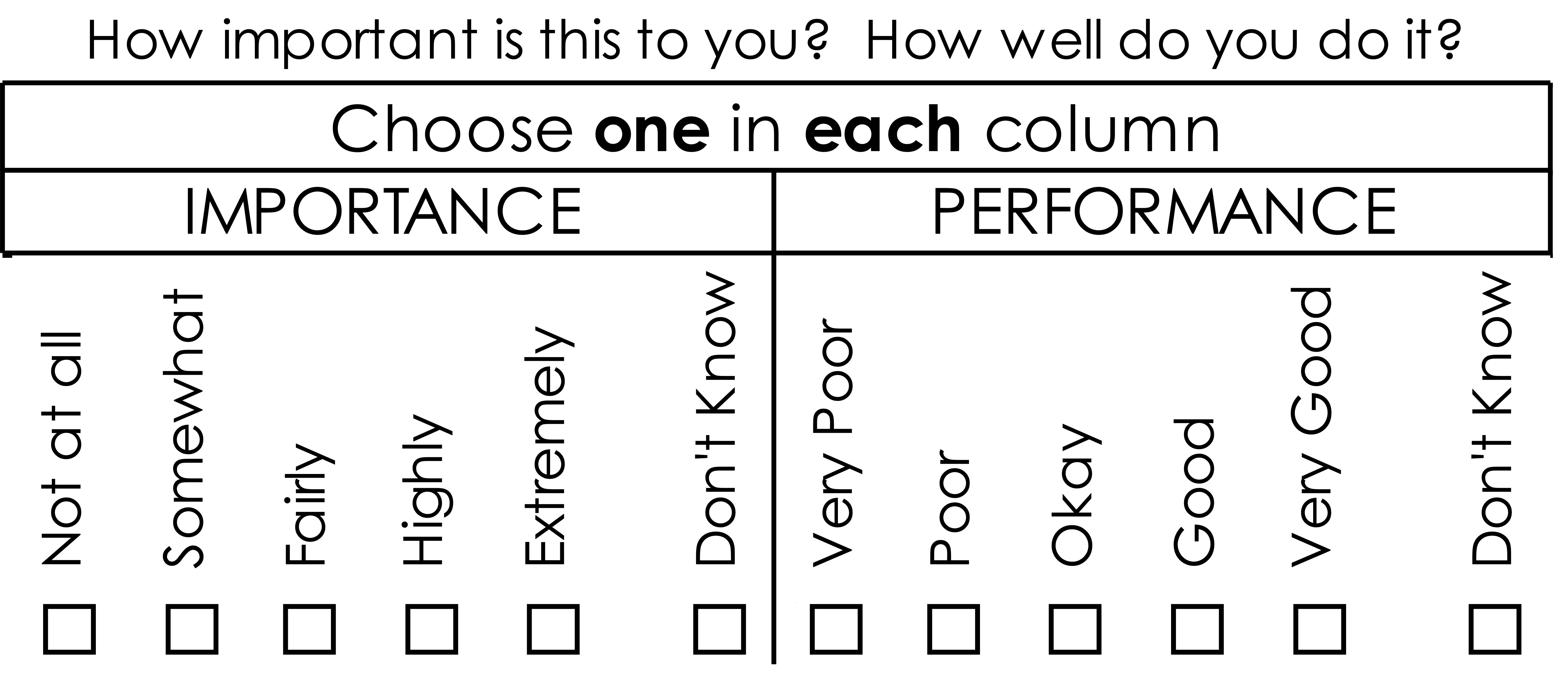
The things we track, we pay attention to. Across time, come back and record your new results. You will find that as you are intentional about making improvements, you will bump your "score" up higher.
This is significant. Don't miss the opportunity to acknowledge your success, and use it as a springboard for making even further gain.
Notes
This book is helpful in understanding why the 80-20 Rule works. And it gives much more detail in how to make best use of it.
The 80/20 Principle, The Secret of Achieving More with Less, Richard Koch,
Here's a very interesting article on a number of areas where the 80-20 Rule has been observed and applied with success.
Here's an article from Asana on how the 80-20 Rule can be used for productivity, quality control and decision-making.
Of course there are many more insightful articles, podcasts and books that make use of the 80-20 Rule. You might want to start with an online search to get you going.
Bottom Line: Learn how to apply the 80-20 Rule to productivity and time management improvement for YOUR work and projects.
And consider working with me if you really need to lock in these get it done, time saving practices. The cost of the coaching retainer will be far surpassed by the efficiencies you build into your work and leadership. Contact me here.
Contact me here Privacy Policy
© G.E.Wood and Associates. All Rights Reserved in all media.
G.E. Wood and Associates is an international coaching firm registered in Ontario, Canada
142 Pratt Crescent, Gravenhurst, Ontario, Canada, P1P 1P5