Make a To Do List that Shows What to Work on Next
- Home
- Basic Productivity Skills
- Make a to Do List That Shows What to Work on Next
Make a to do list that shows what to work on next. For most leaders, executives, and senior level professionals this DOES matter. It continued momentum. It fosters unbroken focus. It provides clarity and saves time.
Having a properly prepared daily work list can be a simple and effective time management tool. With disciplined use, it can help you stay on track and minimize distractions.
The key to developing that list is to make sure that those items you highlight as priorities truly are the priorities. It is a sad fact that many people give a high percentage of low priority items a high priority status.
There are probably two or three list items that will make the biggest difference. Do them first. Review your list throughout the day and re-prioritize as needed.
"The short and long of it is that if we don't dream, we have nothing to strive for. When we stop dreaming and reaching, our God-given talents don't lie in some bank gaining interest so we can use them when we need them. On the contrary, when we stop pursuing dreams and “impossibilities”, our souls dry up."
Bill and Kathy Peel, Discover Your Destiny
Five Days of Coaching to Make a To Do List That Shows What to Work on Next
FIRST DAY OF THOUGHT AND ACTION
Determine to have a plan and work smart. Make a to do list that shows what to work on next. Make this list work for you and not keep you stuck.
If you are lousy at making a list that can clearly differentiate between a true priority and a lesser task, access a reliable time management resource - read a good book about it or work with a coach who has some expertise. The to-do list is your most important tool of the day and has to be well thought out or you will be busy but ineffective.
The Coach asks:
- How willing are you to gain control of your daily task list management?
- What has stood in the way of gaining the control you wish?
- How much time have you traditionally put into making a to do list?
- Where could you get the information you need in order to make the best use of a daily to do list?
- In a very practical way, what format of to do list will serve you best? An app? Word? Excel? Paper?
SECOND DAY OF THOUGHT AND ACTION
Review your default method of creating your daily to-do list. Is it written? Or is it in your head? Do you start with the easiest item first or the hardest? Is most of your day spent putting out to-do list fires or advancing significant priorities? What fundamental changes need to be made to be more effective in accomplishing the few vital things that will reach the most significant outcomes?
The Coach asks:
- How much time can you dedicate today to thinking about and working on to do list management?
- What is your answer to each of the above questions? How did you arrive at that practice or behavior? What needs to change to work differently?
- When is the best time of day to do make a to do list that will guide your activities for the day? The day before? The night before? The morning of that day before things really start rolling? Twice daily? Some other time?
- Draw an arrow to show your intention of moving from "this default practice" to "this more effective practice."
THIRD DAY OF THOUGHT AND ACTION
Do you have a strategic plan? What are you working to achieve? What matters? What are today's priorities? Put these guiding lights clearly in place and you will have something to regularly check your to-do list against. Today, get clear on your life, work or organizational plan and how your daily to-do list either moves it forward or holds it back.
The Coach asks:
- How aligned is your daily to do list with your longer term plan?
- How should the two be aligned to serve you well?
- In what specific ways does your to do list lead you closer each day to achieving longer term goals?
- As you look at the last 5 - 10 days of to do lists, where do you see your larger goals reflected?
FOURTH DAY OF THOUGHT AND ACTION
Use the simplest method of recording and communicating information that works for you and aligns with the needs of those around you who also need to know.
The Coach asks:
- How brief or detailed are your to do lists? How does that help or hold back execution?
- If your to do list needs to be communicated to others, will they "get it?" Do they need to "get it?" What, if anything needs to change?
- If you as a leader can consistently make a to do list that shows what to work on next, AND you can pass that doable method along to your team, imagine the improvement in the work that actually gets done in a timely manner.
FIFTH DAY OF THOUGHT AND ACTION
Review today's to-do list. Does it reflect priorities? Is it a stress maker or a stress buster? Celebrate your great to-do list. Adjust your attitudes and methods where needed.
The Coach asks:
- When you make a to do list that shows what to do next, it's best accompanied with a supportive attitude. Checking your list today. Is it a stress maker or a stress reliever? What does that tell you?
- You've been working on improving your to do list for several days now. How is it going? What additional help or resources might you still need to get it to where you want it?
- Take the time to celebrate the "wins" your list is giving you.
Using the SCANDO Method (with Examples) to Show How to Conquer Your To Do List

THE APP USED FOR THESE EXAMPLES
A simple list may not require a complicated app. Hey, maybe even a good old fashioned planner or notebook will work! But for many of us, using one of the multitude of organizing and project management apps is helpful.
Do not use more technology than you need. Don't make it complicated or you will lose momentum or give up in frustration. Don't listen to all the voices telling you what to do. Find what app or system works for you and stick to it.
The examples you can download here are all done on a very simple app to make illustration easy. I've chosen Microsoft To Do.
EXAMPLE of YOUR 1ST STEP
THE TYPICAL UNORGANIZED TO-DO LIST
Many leaders to-do list simply reflects whatever comes to mind, in whatever order it is thought of.
First download the first example worksheet, Unorganized To Do List
- Grab a sheet of paper and reorder this list as you would if it were part of your normal workday
- Download the SCANDO Method Worksheets in order to insert your own to do list while you look at the examples of how it's done below. These practical worksheets can help you every day to make a to do list that shows what to work on next. That's big!
SCANDO Method Clear worksheet
SCANDO Method Big List worksheet
SCANDO Method First Sort worksheet
SCANDO Method Power of Three worksheet
SCANDO Method Pick One worksheet
SCANDO Method Step by Step worksheet
SCANDO Method Done! worksheet
EXAMPLE of YOUR 2ND STEP
APPLYING THE POWER OF THREE STRATEGY TO THE TO-DO LIST
First, download the second example worksheet, Applying the Power of Three Strategy to the To Do List
- This example shows the same list, having applied the SCANDO Planning Method outlined in 2. Plan Your Day.
- Notice how the list is gaining some order. It's not finished yet, but there's enough to give very clear direction for your day.
- The Big List has been scanned (visually, not in a scanner!) and a First Sort of the list has been done.
- The Power of Three has been applied and from those three priorities, Pick One has been chosen to move forward.
- This has allowed all the Step-by-Step items to be sorted underneath it, leaving only a remaining list of "Other" items you will deal with next.
EXAMPLE of YOUR 3RD STEP
CONTINUE ORGANIZING THE UNASSIGNED ITEMS ON YOUR TO-DO LIST
First, download the third example worksheet, How to Organize the Remaining To Do List Items by Type
- There will always be an assortment of "leftover" items on your to-do list, after you have done your main organization.
- Take the time to organized those remaining items. Some must be handled according to time. Others need to be done today. Others may be personal errands. Still others could all be handled at one sitting. Find that order as illustrated and apply it to your own to do list.
Your planning will only take a few minutes of time each day. Once a habit, it really doesn't take long to make a to do list that shows what to work on next. The net result will be clarity about what's important and where you will apply your time and efforts for this day.
A Discerning Person Keeps Wisdom in View
As a Christian Executive Leadership Coach I encourage any Christian leaders to reflect on God's Word to add to their wisdom.
- Mt 10:5 - 8 These twelve Jesus sent out with the following instructions: proclaim this message ... heal the sick ... raise the dead ... cleanse those who have leprosy ... drive out demons. ...
- Pr 17:24 A discerning person keeps wisdom in view, but a fool's eyes wander to the ends of the earth.
- Php 1:6 .. being confident of this, that he who began a good work in you will carry it on to completion until the day of Christ Jesus.
- 1 Cor 9:26 Therefore I do not run like someone running aimlessly; I do not fight like a boxer beating the air.
If you are a leader, executive, or senior level professional looking to work with a Christian Executive Coach, I invite you to connect with me here.
If appropriate, we can meet by phone or Zoom to discuss your situation.
Record Your Progress
This is your opportunity to track your progress. Start by asking yourself how important this practice is to you? Record the importance as - not at all, somewhat, fairly, highly or extremely.
Now next to it ask yourself how well you carry out this practice. Record your performance as - very poor, poor, okay, good or very good.
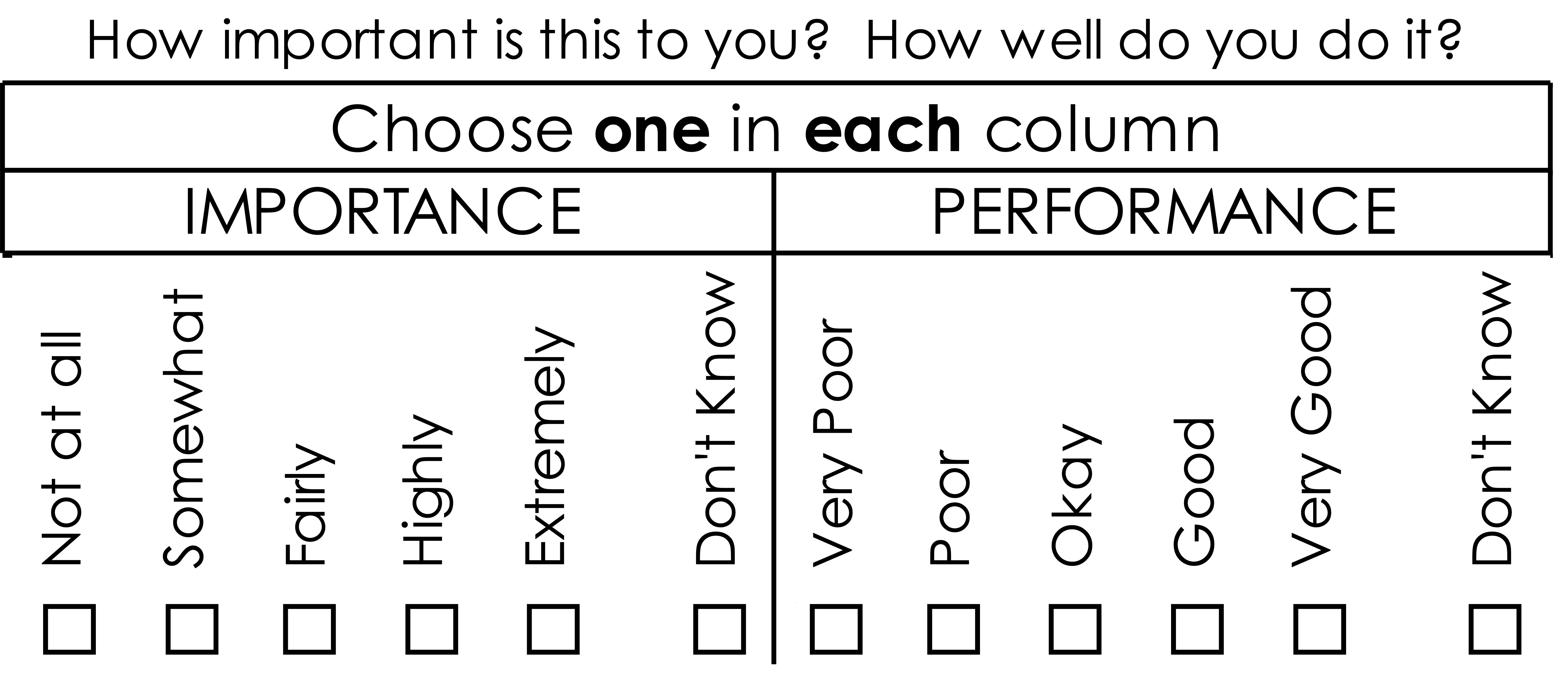
The things we track, we pay attention to. Across time, come back and record your new results. You will find that as you are intentional about making improvements, you will bump your "score" up higher.
This is significant. Don't miss the opportunity to acknowledge your success, and use it as a springboard for making even further gain.
Notes
Almost every leader or executive I talk to, uses a slightly different tool for making a to do list. Literally there are hundreds of them. You will need to take the time, and do some experimenting to find the right platform or tool that will work best for you. And there's the key ... make it work for you. It's not somebody else's to do list. It's yours.
Having said that ... Make a to do list that shows what to work on next. As I've indicated, it will be a game changer if you've had trouble creating and following a to do list before.
Like tools, there are many books, articles and podcasts on how to make a to do list that works. Like everything else, do an online search and you'll find some superb resources.
Contact me here Privacy Policy
© G.E.Wood and Associates. All Rights Reserved in all media.
G.E. Wood and Associates is an international coaching firm registered in Ontario, Canada
142 Pratt Crescent, Gravenhurst, Ontario, Canada, P1P 1P5